IN SHORT
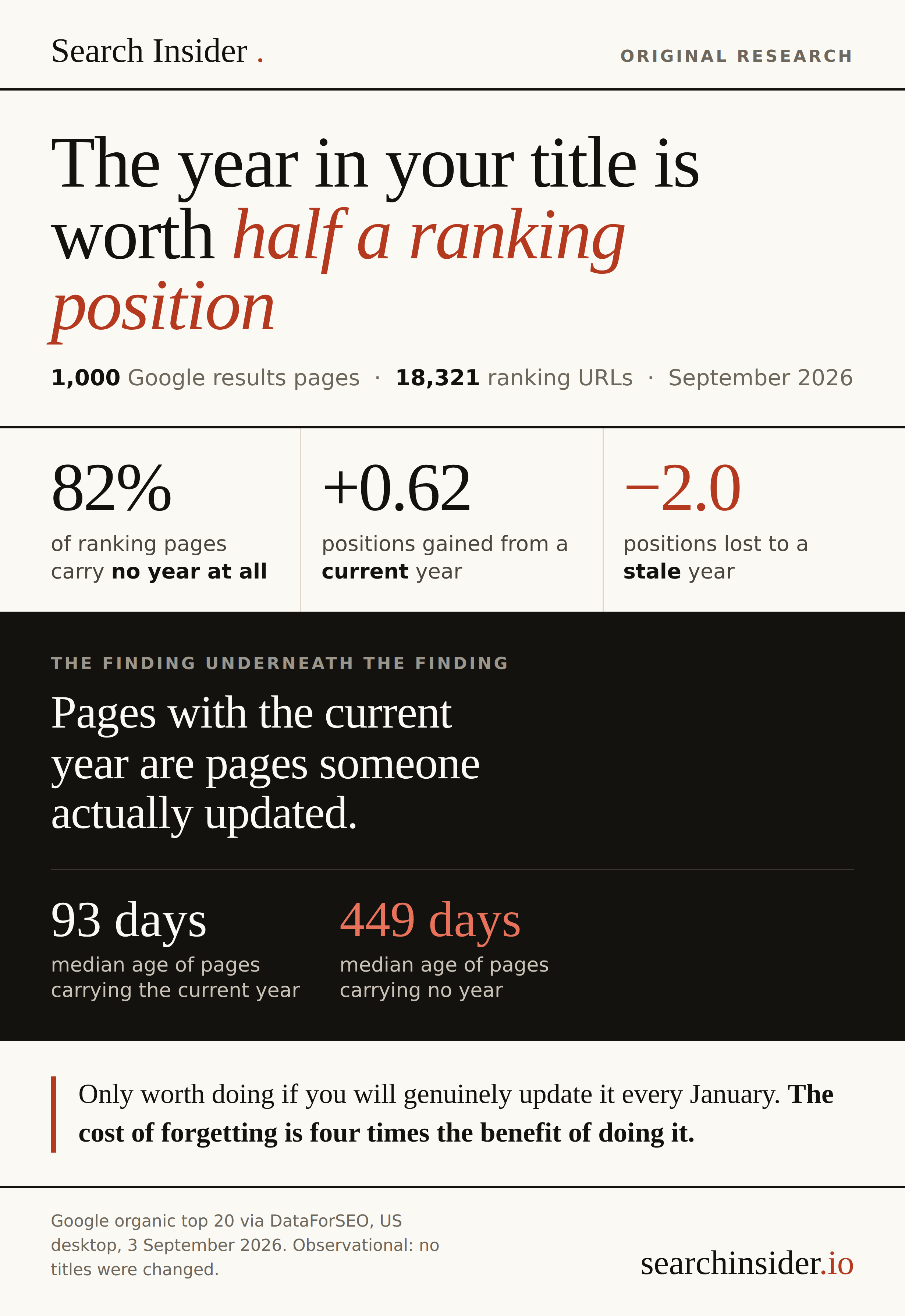
Putting the current year in a title tag is associated with ranking about 0.62 positions higher, measured by comparing pages competing on the same results page. Roughly a third of that advantage is explained by those pages simply being newer, rather than by the year itself.
82% of pages ranking in Google's top 20 carry no year in the title at all.
A current year is worth about half a position. A stale year costs about two.
Pages carrying the current year have a median age of 93 days. Pages carrying no year: 449 days.
On evergreen informational queries, fewer than 1% of ranking pages use a year.
The practice is 3.2 times more common in marketing and SEO than in beauty, which is what a publishing convention looks like rather than a ranking mechanic.
The tactic is only worth running if you will genuinely update it every January. The cost of forgetting is four times the benefit of doing it.
There is a page sitting at number one in Google right now for a competitive product query, and its title says 2021. Not 2026. Five years out of date, in a category where the products turn over annually, and it is still holding the top position against six competitors who have all dutifully updated their titles to the current year.
I found it while testing something I had repeated myself for years without ever checking. Put the current year in your title. Best CRM 2026. Best running shoes 2026. It is in essentially every SEO guide written in the last decade, it is a default recommendation in most content briefs, and as far as I can establish, nobody had run it at scale.
So I did. Here is what 18,321 ranking pages say about it.
Method
One thousand search terms, built as twenty industries by fifty queries each and frozen before any data was collected. Seven hundred were freshness-sensitive commercial searches (best, top, cost of, cheapest) and three hundred were evergreen informational queries. Roughly half were long-tail.
Google's organic top 20 was pulled for every one of them on 3 September 2026, US desktop, giving 18,321 ranked URLs across 6,872 distinct domains. Every variable (year present in the title, whether that year is current or stale, position band, page age) was assigned programmatically from the raw title and URL strings. No result was categorised by hand, and a random sample was audited against the source data afterwards.
Nobody is doing this
I expected year-stamping to be close to universal. It is not. Four out of five pages currently ranking do not use it.
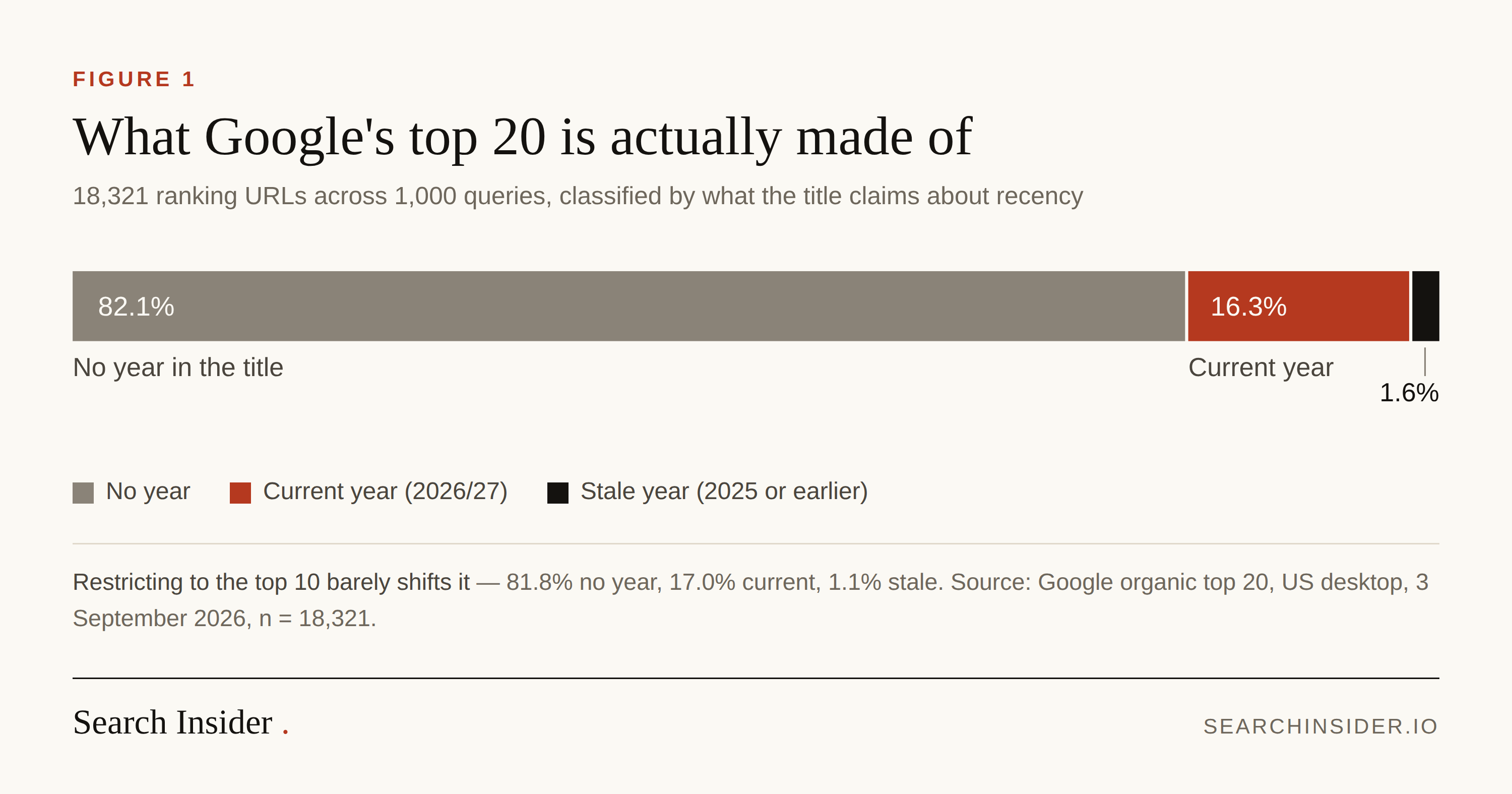
Restricting to the top 10 barely shifts it: 81.8% no year, 17.0% current, 1.1% stale. Source: Google organic top 20, US desktop, 3 September 2026, n = 18,321.
The intent split is starker still. On the freshness-sensitive commercial queries, roughly a quarter of results carry a year. On the evergreen set (how to sharpen a knife, what is compound interest, how does a compass work) it is 41 results out of 5,308. Under one per cent.
That is not a gentle preference. On informational queries the practice is effectively absent from the results, which tells you the market resolved this question a long time ago even if the guides never caught up.
The habit belongs to one industry more than the rest
Split the commercial queries by vertical and the range is more than three-fold.
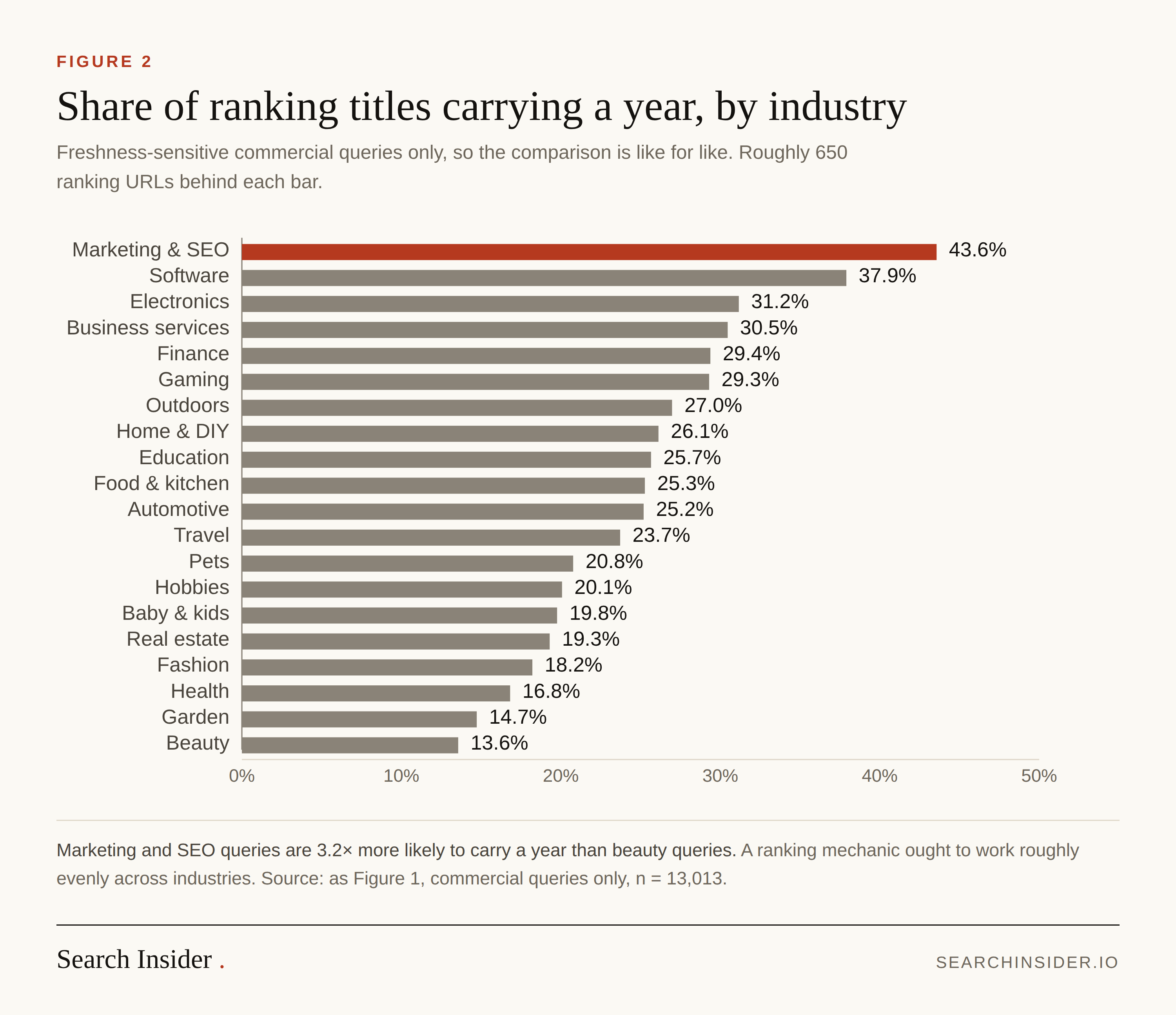
Marketing and SEO queries are 3.2 times more likely to carry a year than beauty queries. A ranking mechanic ought to work roughly evenly across industries. Source: as Figure 1, commercial queries only, n = 13,013.
A genuine ranking factor should not care what industry it is operating in. This one maps almost perfectly onto publishing culture. That is the first sign we are looking at a convention that spread through an industry, not a lever anyone at Google built.
It works, but not by much
To measure the effect honestly you have to compare like with like, which means comparing pages within the same results page rather than comparing easy searches against hard ones. Six hundred and ninety-seven of the thousand queries had both year-stamped and un-stamped pages competing directly.
Across those, a year in the title is associated with sitting 0.62 positions higher. Weight all twenty industries equally so that no single vertical dominates and the figure holds at 0.64, pointing the same direction in fifteen of the twenty. It is a real effect. It is also about two thirds of one slot on a page of ten.
The year is worth roughly half a position. Getting it wrong costs you two.
The cost of getting it wrong is the more useful number, and it is bigger.
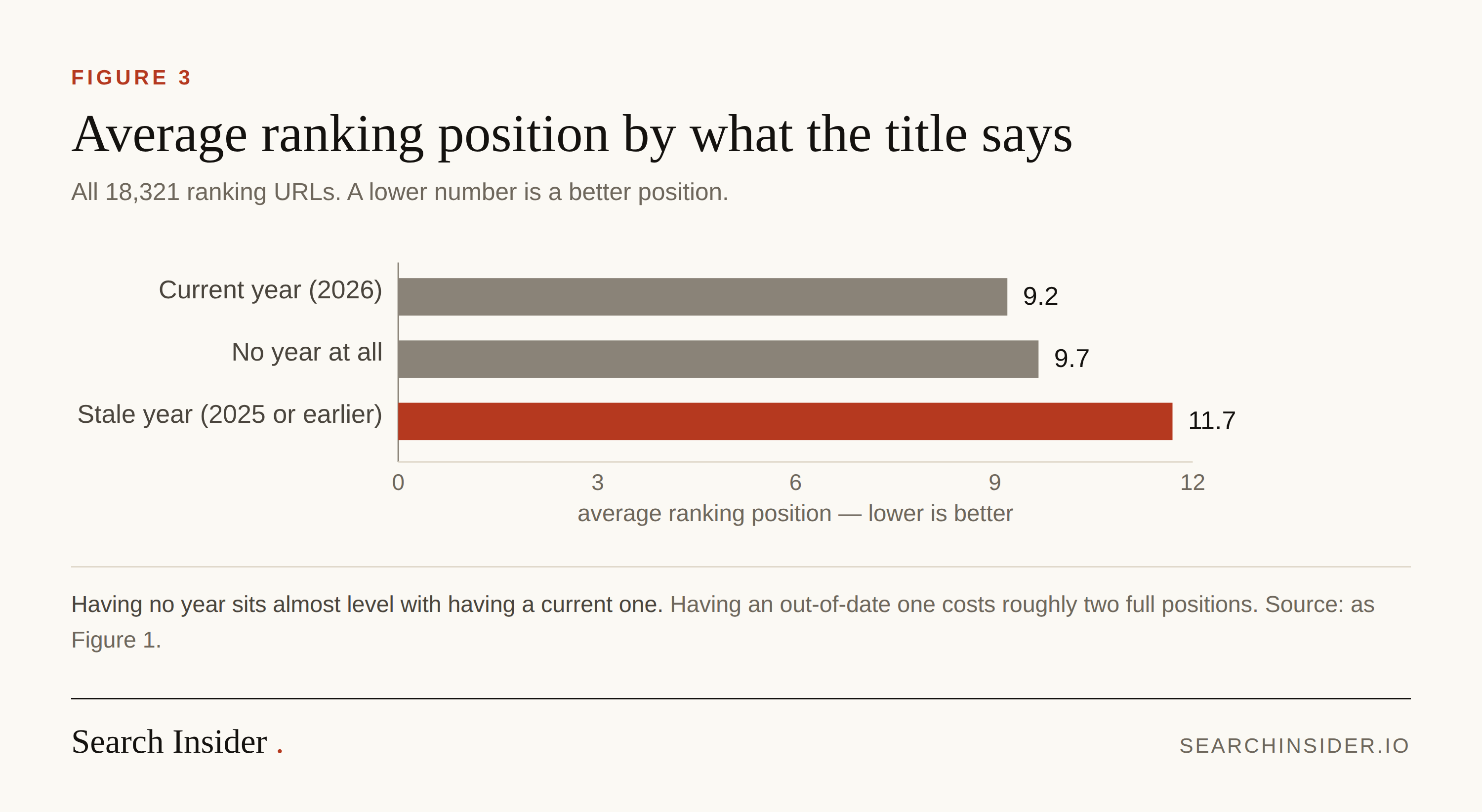
Having no year sits almost level with having a current one. Having an out-of-date one costs roughly two full positions. Source: as Figure 1.
The gap between a current year and no year at all is about half a position. The gap between a stale year and no year at all is two. The downside of getting this wrong is roughly four times the upside of getting it right. The tactic is only worth running if you will genuinely go back and change it every January.
Most people will not. That is not a criticism; it is simply what happens to a maintenance task with no deadline attached to it.
What the year is actually measuring
Pages with the current year in the title are pages someone actually updated.
Google publishes a last-updated date on roughly half of all organic results. Cross-referenced against which titles carry a year, something I can find no prior record of anyone doing, pages carrying 2026 are dated at a median of 93 days old. Pages carrying no year at all: 449 days.
That is a five-fold difference in page age, sitting directly underneath the effect we just measured. Nobody stamps the current year on an article and then leaves it untouched. The two things travel together, which means a straightforward comparison of year-stamped against un-stamped pages is partly measuring freshness and calling it something else.
Holding page age constant, roughly a third of the advantage disappears.
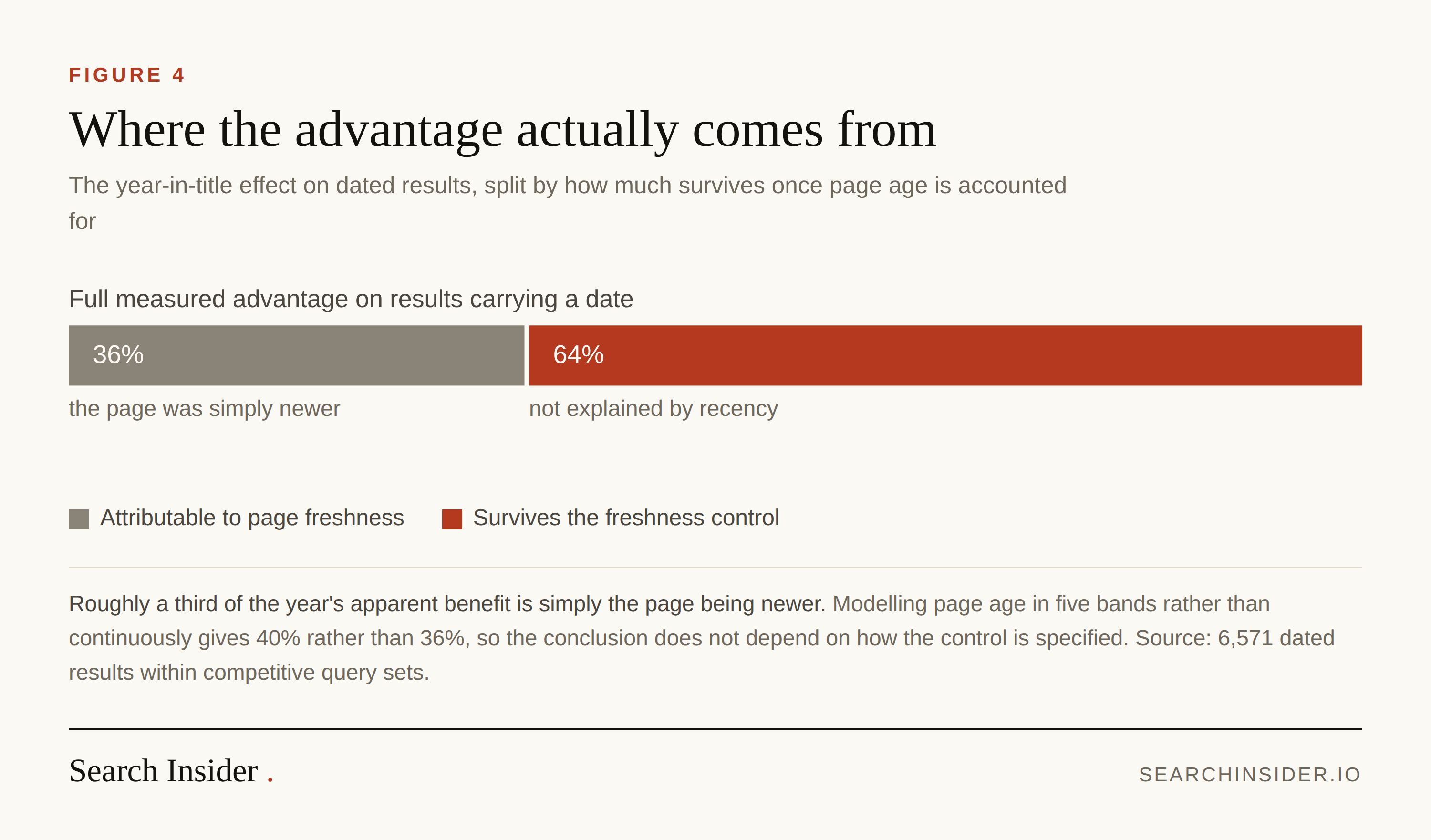
Roughly a third of the year's apparent benefit is simply the page being newer. Modelling page age in five bands rather than continuously gives 40% rather than 36%, so the conclusion does not depend on how the control is specified. Source: 6,571 dated results within competitive query sets.
So it was never entirely the number. A meaningful share of it was somebody going back and doing the work. The year in the title is just the most visible residue of it, the part that shows up in a screenshot.
What remains after the control is not nothing, and I want to be careful here rather than overclaim. Roughly two thirds of the effect survives, and this study cannot tell you whether that residue is the token itself or whether publishers who keep their titles current also differ in a dozen other ways it cannot observe. Both readings are consistent with the data.
Pages ranking on years that expired long ago
If the current year were carrying real weight, pages stuck on an old one should have been flushed out months ago. We are nine months into 2026. They have not been.
Two hundred and eighty-five results, 1.6% of the sample, carry a year that has already expired, spread across 225 different searches. A hundred and fifteen of them sit in the top ten. Three hold position one outright, and the tail runs back five years.
| Rank | Title | Domain |
|---|---|---|
| 1 | The best wireless headset for programming in 2021 | thatsoftwaredude.com |
| 1 | Kitchen Remodel Costs in 2025: 3 Realistic Levels | reddit.com |
| 1 | Five Budget 3D Printers for Beginners in 2025 | stldenise3d.com |
| 2 | Best fitness trackers for sensitive skin 2024 | gearbrain.com |
| 2 | Top 10 Business Registration Services in 2024 | jpost.com |
| 3 | Top Noise-Canceling Headphones for Developers in 2025 | levelup.gitconnected.com |
A title claiming 2021 is still ranking first, five years on. Whatever Google is rewarding here, it is plainly not checking the number against the calendar.
What to do with this
The practical guidance is narrower than the advice it replaces, and most of it is about maintenance rather than optimisation.
| If this is your situation | Then |
|---|---|
| You already have years in your titles | Keep them current. This is the clearest finding in the study. An expired year costs roughly two positions, which is worse than never having added one. |
| You cannot commit to updating them annually | Leave them off. The upside is half a position and the downside is two. The arithmetic does not work if the task will be forgotten. |
| The page is evergreen | Leave it off. Under 1% of ranking results on informational queries carry a year, and nothing in the data suggests it helps there. |
| You are choosing between adding a year and updating the page | Update the page. A third of the year's measured benefit comes from freshness regardless, and that is the part within your control. |
| Your competitors all do it | Match the norm; expect no edge. Prevalence is about a quarter on commercial queries, and 44% in marketing and SEO. It is convention, not an edge. |
| You are hoping this rescues a struggling page | It will not. Half a position does not save anything. The problem is elsewhere. |
Where this breaks down
Several things this study cannot tell you, which matter as much as what it can.
It measured rankings, not clicks. A current year in a search result plausibly earns its keep by looking maintained and pulling the click. That was not tested here, and it may well be where the real value sits.
It is observational. No title was changed to see what happened. Establishing cause requires taking a set of pages, adding the year to half of them at random, and watching what moves. That is the obvious next study, and I intend to run it.
Google's date stamp is not a true last-modified date. It is what Google elects to display, on roughly half of results. The freshness control is only as good as that proxy.
Dated results are a selected subset. The raw effect within them is larger than across the sample as a whole, because Google surfaces dates on precisely the kinds of pages where recency is relevant. The 36% split is measured inside that subset and should not be applied to the headline figure.
One snapshot, US desktop. Taken nine months into 2026. The stale-year numbers would look materially different in January.
The wider pattern
I have been picking apart accepted search advice for a while now, and this one fits a shape I keep running into. The year in a title tag is a cheap, visible imitation of a thing that is expensive and invisible: actually maintaining the page. One takes an afternoon and a find-and-replace. The other takes a writer.
I have done the cheap version myself, more than once, and logged it as a content refresh with a straight face. The number changed. The content did not.
That is the trap, and it is not unique to this tactic: word count standing in for depth, schema markup standing in for structure, an author box standing in for expertise. Each is a legible proxy for something that resists measurement, and each becomes the thing we optimise precisely because it is the thing we can see. Testing them one at a time is the only way I know to tell which are load-bearing and which are decoration.
This one turns out to be a bit of both.
Reuse this
Data availability. The full dataset (18,321 ranking URLs with title classification, position, domain and date fields) is available on request. Collection: Google organic top 20 via DataForSEO, US desktop, 3 September 2026. Query frame fixed prior to collection.
Corrections. If you spot an error in the method or the figures, I would rather know. Corrections are noted inline and dated.